What Are Described as the Two Components of Constructivist Art?
Articles and Features
Art Movement: Constructivism
"Nosotros DECLARE UNCOMPROMISING State of war ON ART!"
– Aleksei Gan
In 1913, the Russian artist Vladimir Tatlin paid a visit to Picasso's studio. What he saw there were Picasso'south experiments with collaged objects (papiers collés). This encounter profoundly influenced Tatlin, who embarked on an exploration of his own in the collage medium, creating abstract, three-dimensional collages fabricated of metallic and wood. He exhibited these alongside Kasimir Malevich'southward Suprematist paintings at the "Last Futurist Exhibition" that year. This marked the beginning of Constructivism, an art move in which the artists were interested in construction. Art was to be congenital.
What is Constructivism?
In Constructivism, the role of the artist was re-imagined – the artist became an engineer wielding tools, instead of a painter holding a castor. For the Constructivists, artworks were office of a greater visual program meant to awaken the masses and atomic number 82 them towards awareness of class divisions, social inequalities, and revolution. The Constructivists believed that art had no place in the hermetic space of the artist's studio. Rather, they thought that art should reflect the industrial world and that information technology should be used as a tool in the Communist revolution.
Key dates:1915-1940
Key regions:Soviet Marriage, Germany
Central words:abstraction, geometric forms, social purpose, Communism, revolution
Key artists:Alexander Rodchenko, Varvara Stepanova, Vladimir Tatlin, Gustav Klutsis, El Lissitzky, Liubov Popova
Constructivist Style
Constructivist art focused on industrial production. Constructivists used stripped down, geometric forms and minor materials. Their visual language existed of forms that they could draw with practical instruments like compasses and rulers. Materials like forest, glass and metallic were analysed and judged on the footing of how suitable they were for use in mass-produced objects and images.
Constructivism in the Soviet Union
The Russian Revolution had taken identify in 1917, and the country was freeing itself from the grips of the ruling aristocracy. The desire was to revolutionise all aspects of Russian federation, including its cultural life. Fine art was to be in service of the new, Communist order.
The Soviet Union was formed in 1922, the same yr in which Russian artist Aleksei Gan wrote a manifesto that began with the post-obit words: "We DECLARE UNCOMPROMISING WAR ON Fine art!" Aleksei Gan, Vladimir Tatlin and Alexander Rodchenko are considered the founding members of Constructivism. They were soon joined by artists including Varvara Stepanova, Liubov Popova and El Lissitzky. These artists were interested in creating art that would serve the masses. They attempted to find the Communist expression of material construction. Building and scientific discipline were emphasised over artistic expression, and Constructivism reached as far and broad as compages, design, fashion, and mass-produced objects. Construction ruled over, for example, classic painterly concerns such as composition.

Famous Constructivist Artworks
Vladimir Tatlin'sTatlin's Tower(1919)
Tatlin'due south Tower, too known as theMonument to the Third International, was Tatlin's pattern for a monumental building that was to be erected in St. petersburg as the headquarters and monument of the Comintern (Tertiary International). It was envisioned as a towering symbol of modernity, built from industrial materials like glass, steel, and iron. Though the tower was never realised, it has become one of the symbols of Constructivism.
El Lissitzky'sProun Room(1923)
Proun Roomis an installation of dynamic abstract forms that announced to exist floating, and which are meant to activate the viewer, propelling them around the space.
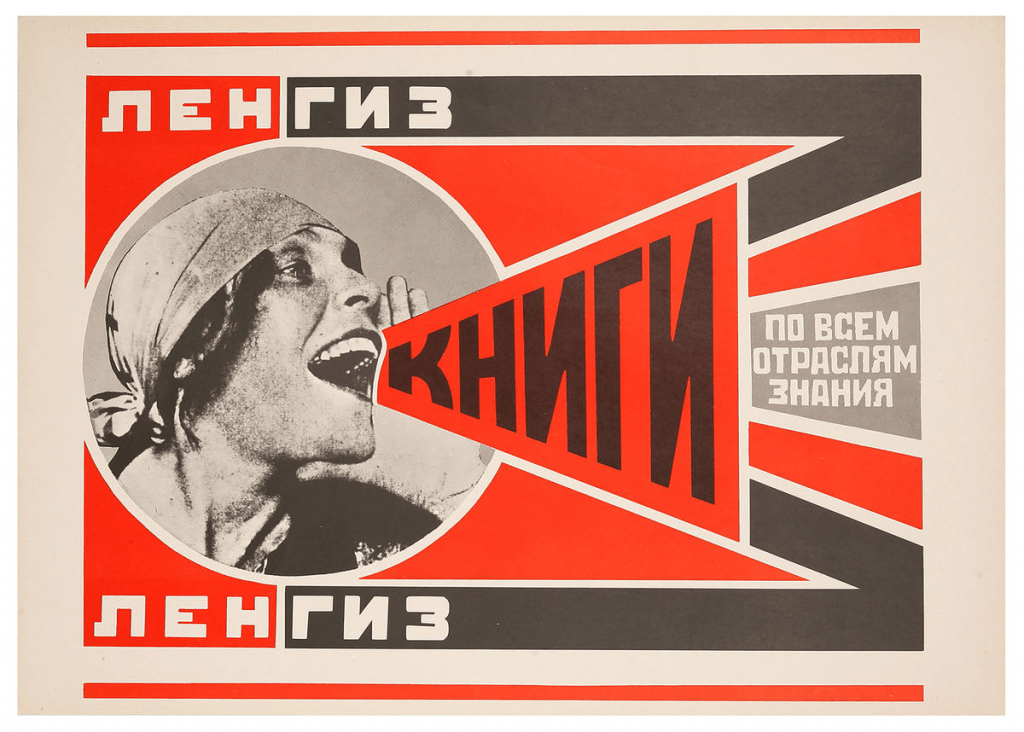
Alexander Rodchenko'sBooks (Please)! In All Branches of Noesis (1924)
This iconic Constructivist artwork depicts a woman shouting the words in the title of the slice in sharp, linear forms. This gives the artwork a sonic dimension.
Constructivism in Germany
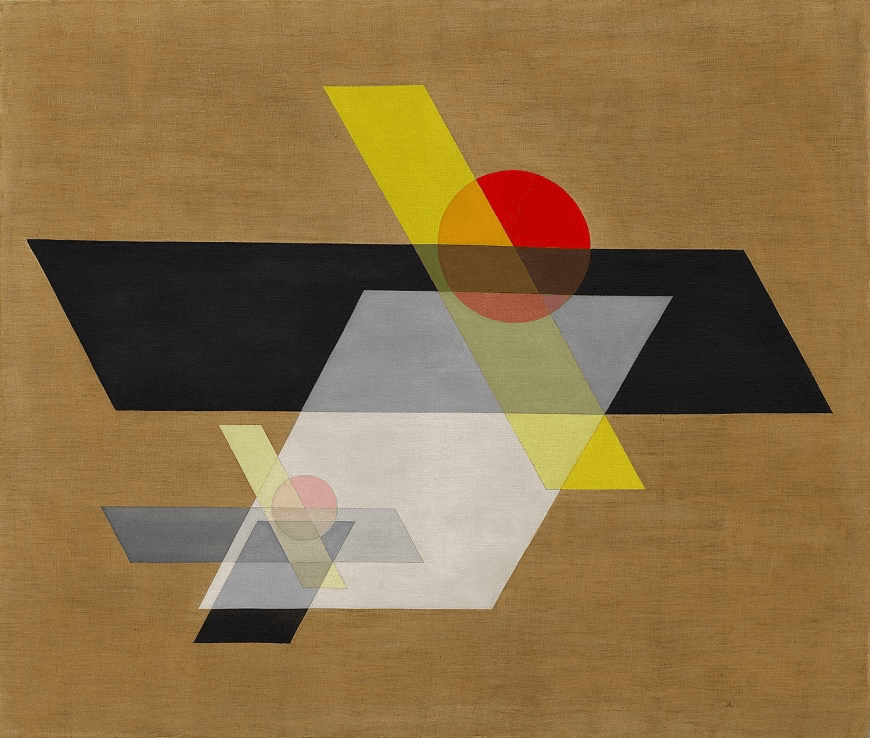
Constructivism was taken up by many artists in Germany. One of the almost of import artists influenced past Constructivism in Germany was László Moholy-Nagy, who had come from Republic of hungary to Deutschland where he taught at the Bauhaus. El Lissitzky, who became the Russian cultural ambassador to Weimar Germay, and Naum Gabo, who spent time in Berlin and was affiliated with the Bauhaus, likewise contributed a great deal to spreading Constructivism in Germany.
The Impact of Constructivism
Constructivism may accept originated in Russia, merely it before long spread out across the continent, for case through the many Constructivists who taught at the Bauhaus in Germany. By the mid 1920s, the movement was in decline due to the increasing hostility of the Bolshevik regime towards avant-garde art. Nevertheless, the motility connected to flourish throughout the W until the 1940s. In England, for instance, a version of Constructivism was established in the 1930s and 1940s.
Joaquín Torres García and Manuel Rendón helped disseminate Constructivism throughout Europe and Latin America. In Latin America, artists including Carlos Mérida, Enrique Tábara, Aníbal Villacís and Oscar Niemeyer were greatly influenced past the motion. Its influence can besides be seen on Minimalist artists, who were occupied with reducing form down to its almost essential elements.
Constructivism FAQ
What is Constructivism in art
Rather than emerging from an expressive impulse or an academic tradition, the art is to be congenital. Constructivist art focused on industrial production. Constructivists used stripped down, geometric forms and modest materials. Their visual language existed of forms that they could depict with practical instruments like compasses and rulers. Materials similar wood, glass and metal were analysed and judged on the ground of how suitable they were for use in mass-produced objects and images.
Who was the founder of Constructivism Fine art
Constructivism was an artistic and architectural theory that originated in Russia at the get-go of 1913 by Vladimir Tatlin. This was a rejection of the idea of democratic fine art by amalgam it. The motion supported fine art as a practice for social objectives.
What influenced Constructivism?
Constructivism was first influenced past both Cubism and Futurism and is by and large considered to have been initiated in 1913 with the "painting reliefs" – abstract geometric constructions of Vladimir Tatlin. Lissitzky's combination of Constructivism and Suprematism later influenced the de Stijl artists and architects whom he met in Berlin, as well as the Hungarian László Moholy-Nagy.
Relevantsources to learn more than
Learn well-nigh Minimalism
Source: https://magazine.artland.com/art-movement-constructivism/
0 Response to "What Are Described as the Two Components of Constructivist Art?"
Enregistrer un commentaire