National Federation of Independent Business (Nfib) V. Sebelius Read
From Ballotpedia
Bound to: navigation, search

 | |
| National Federation of Independent Concern v. Sebelius | |
| Docket number: 11-393 | |
| Court: United States Supreme Court | |
| Courtroom membership | |
| Chief Justice John Grand. Roberts Associate Justices Antonin Scalia Anthony Kennedy • Clarence Thomas Ruth Bader Ginsburg • Steven G. Breyer Samuel Alito • Sonia Sotomayor • Elena Kagan | |
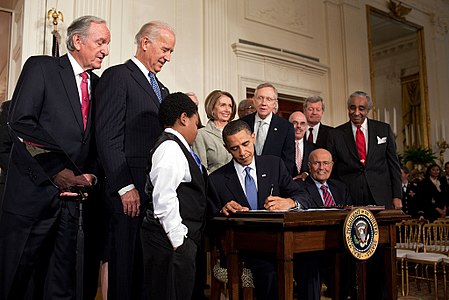
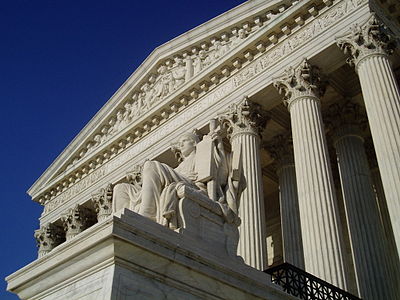
National Federation of Independent Business v. Sebelius was a United states Supreme Court case regarding the individual mandate and Medicaid expansion provisions of the Affordable Care Act (ACA). Nether the provisions in question, the ACA required well-nigh individuals to maintain minimum wellness insurance coverage and required states to expand their Medicaid programs or else lose federal Medicaid funds. The court upheld the individual mandate as a legitimate exercise of Congress' Commodity I taxing ability and found that state participation in the Medicaid expansion program was voluntary.
HIGHLIGHTS
In brief: The plaintiffs alleged that the ACA's private mandate and Medicaid expansion provisions were unconstitutional. The Supreme Court upheld the private mandate every bit a legitimate exercise of Congress' Article I power to lay and collect taxes rather than its authority to regulate interstate commerce, concluding that the penalty is a tax. The court also institute that country participation in the ACA's Medicaid expansion was voluntary, merely was silent on the question of whether the individual mandate could exist severed from the remainder of the law.
Why information technology matters: NFIB five. Sebelius antiseptic the scope of Congress' authority to regulate interstate commerce under the Commerce Clause of Commodity I. In the stance for the court, Master Justice John Roberts wrote, "The court today holds that our Constitution protects us from federal regulation under the Commerce Clause so long equally we abjure from the regulated activeness. But from its creation, the Constitution has made no such promise with respect to taxes."[two]
Background
| The Administrative Country Project |
|---|
 |
| Five Pillars of the Administrative State |
| • Judicial deference • Nondelegation • Executive control • Procedural rights • Agency dynamics |
| Click hither for more coverage of the administrative state on Ballotpedia |
The Patient Protection and Affordable Care Act, likewise known as the Affordable Care Act (ACA) or Obamacare, was enacted with the primary aim of expanding health insurance coverage to more people. To that finish, the police required most individuals to acquire and maintain minimum health coverage or be penalized. It also required states to expand eligibility for their Medicaid programs to all individuals with incomes up to 138 percentage of the federal poverty level. If the land refused to expand, the law said that the federal government could completely withhold its portion of Medicaid funding from the state.[3] [4]
Less than two months subsequently the law was enacted, a federal lawsuit was filed in Florida, consisting of 26 states, 2 individuals, and an independent organization. The following plaintiffs joined: The Attorneys General of Arizona, Indiana, Mississippi, Nevada, Due north Dakota, Alabama, Colorado, Florida, Idaho, Louisiana, Michigan, Nebraska, Pennsylvania, Southward Carolina, South Dakota, Texas, Utah, Washington, Georgia, Alaska, Ohio, Wisconsin, Kansas, Maine, Iowa, and Wyoming; Mary Brown and Kaj Ahlburg; and the National Federation of Independent Business organisation. The lawsuit was brought to the federal District Courtroom for the Northern Commune of Florida by Florida state Attorney Full general Bill McCollum on March 23, 2010.[5] [six]
The lawsuit challenged the Affordable Care Act on the grounds that the individual health insurance mandate exceeded Congress' dominance to regulate interstate commerce under the Commerce Clause of Article I and did not fall within its power to tax. The complaint farther alleged that the act violated the Tenth Amendment past compelling states to follow federal regulations.[5]
The U.Southward. District Court for the Northern Commune of Florida ruled on January 31, 2011, that the individual mandate of the Affordable Care Act exceeded Congress' potency. Information technology also ruled that the private mandate could not be severed from the rest of the Affordable Intendance Act, thus striking the entire act. Nevertheless, it establish in favor of the federal government with regard to the Medicaid expansion.[4]

The federal government appealed the ruling, which then went to the Eleventh Excursion Court of Appeals. The Eleventh Excursion affirmed in part and reversed in function the judgment of the lower court. Information technology agreed that the Medicaid expansion provision was not unconstitutionally coercive and that the individual mandate was unconstitutional. Even so, the Eleventh Excursion held that "the individual mandate could be severed without invalidating the remainder of the ACA."[4]
The Supreme Court granted certiorari on November 13, 2011, and oral arguments were held on March 25 through March 27, 2012.[4]
Decision
| | | | | |


On June 28, 2012, the Supreme Court overturned the judgment of the Eleventh Circuit in a 5-four decision. The majority opinion was written past Chief Justice John Roberts and joined in role by Justices Ruth Bader Ginsburg, Stephen Thousand. Breyer, Sonia Sotomayor, and Elena Kagan.[4]
The Court upheld the Affordable Care Act's individual mandate equally a legitimate exercise of Congress' Article I power to lay and collect taxes, last that the penalty is a tax. Principal Justice John Roberts wrote, "The courtroom today holds that our Constitution protects usa from federal regulation under the Commerce Clause and so long every bit we abstain from the regulated activity. But from its creation, the Constitution has made no such promise with respect to taxes." The court held, however, that Congress did not have such say-so under the Commerce Clause.[iv] [7] [8]
The courtroom also concluded that, by cutting off all Medicaid funding to states that refused to expand the program, the federal regime was engaging in coercion. The court stated that the police transformed the original Medicaid program into "an element of a comprehensive national plan to provide universal health insurance coverage." Even so, it upheld the Medicaid expansion provision otherwise, effectively making the expansion voluntary on the part of the states.[4]
The courtroom did non rule on whether the private mandate was severable from the police force.[4]
Dissent
| Federalism |
|---|
 |
| |
| Click here for more coverage of federalism on Ballotpedia |
Justices Antonin Scalia, Anthony Kennedy, Clarence Thomas, and Samuel Alito dissented. The dissenting stance did concord that the individual mandate was not a legitimate regulation of interstate commerce, because it compelled people to appoint in detail transactions rather than regulating existing transactions: "the mere fact that nosotros all consume food and are thus, sooner or afterwards, participants in the 'market place' for food, does non empower the Regime to say when and what nosotros will buy. That is essentially what this Act seeks to do with respect to the purchase of health care." The dissenters argued that the individual mandate represented an unprecedented corruption of federal power, for the federal government has "never before used the Commerce Clause to hogtie entry into commerce."[viii] [ix]
However, the dissenting opinion also argued that the individual mandate was not a legitimate exercise of the power to taxation, considering the statute described the fine as a "penalty" rather than a tax. The opinion also ended that the Affordable Care act should be overturned in its entirety, every bit it could non function as intended without the private mandate.[viii]
In addition, the dissenting opinion argued that the Medicaid expansion in its entirety was unconstitutional due to the provision that nonparticipating states would have their federal Medicaid funding revoked. The authors wrote that the courtroom does not accept the power to rewrite the law and remove the penalizing provision. That dominance, the opinion states, belongs to Congress.[eight]
Run across also

External links
- Supreme Court of the The states, "National Federation of Contained Business v. Sebelius"
- The Henry J. Kaiser Family Foundation, "A Guide to the Supreme Court'southward Determination on the ACA'southward Medicaid Expansion"
- Oyez, "National Federation of Independent Businesses five. Sebelius"
Footnotes
- ↑ Supreme Court of the The states, "National Federation of Independent Business five. Sebelius," accessed May 20, 2016
- ↑ [https://fas.org/sgp/crs/misc/R42698.pdf Congressional Enquiry Service, "NFIB five. Sebelius: Constitutionality of the Individual Mandate," September 3, 2012]
- ↑ The Henry J. Kaiser Family Foundation, "A Guide to the Supreme Courtroom's Decision on the ACA'south Medicaid Expansion," August 1, 2012
- ↑ iv.0 4.ane 4.2 four.3 4.iv 4.5 four.6 4.7 Oyez, "National Federation of Independent Businesses v. Sebelius," accessed May 20, 2016
- ↑ 5.0 5.1 Usa District Court for the Northern District of Florida, Pensacola Partitioning, "National Federation of Contained Business organisation five. Sebelius, Amended Complaint," accessed May xx, 2016
- ↑ United States District Court for the Northern District of Florida, Pensacola Sectionalization, "National Federation of Independent Concern 5. Sebelius, Original Complaint," accessed May xx, 2016
- ↑ Christian-Science Monitor, "How John Roberts upheld health-care law while limiting congressional power," June 28, 2012
- ↑ eight.0 8.1 eight.ii 8.iii Legal Information Institute, "National Federation of Independent Businesses v. Sebelius," accessed May 20, 2016
- ↑ Justia, "Nat'l Fed'n of Indep. Coach. v. Sebelius, Dissent," accessed May xx, 2016
| The Administrative Country Projection | ||
|---|---|---|
| Main | The Administrative State Project principal page • Administrative State Projection Index • Glossary of authoritative country terms • Quotes about the administrative state • Administrative state • Rulemaking • Deference • Adjudication • Nondelegation doctrine |  |
| Reporting | Changes to the Federal Register • Completed OIRA review of federal authoritative agency rules • Federal agency rules repealed under the Congressional Review Act • Historical additions to the Federal Register, 1936-2016 • Pages added monthly to the Federal Register, 1995-2017 | |
| Laws | Administrative Process Act • Antiquities Act • Civil Service Reform Human activity • Clayton Antitrust Human action • Communications Human activity of 1934 • Congressional Review Act • Electronic Liberty of Information Act • Federal Food, Drug, and Cosmetic Deed of 1938 • Federal Housekeeping Statute • Federal Reserve Act • Federal Trade Commission Human activity of 1914 • Freedom of Data Act • Government in the Sunshine Human action • Contained Offices Appropriations Human action of 1952 • Information Quality Act • Interstate Commerce Human action • National Labor Relations Act • Paperwork Reduction Act • Pendleton Act • Privacy Act of 1974 • Regulatory Flexibility Human activity • REINS Act • REINS Act (Wisconsin) • Securities Act of 1933 • Securities Exchange Human activity of 1934 • Sherman Antitrust Deed • Minor Business Regulatory Enforcement Fairness Act • Truth in Regulating Human action • Unfunded Mandates Reform Act | |
| Cases | Abbott Laboratories v. Gardner • A.L.A. Schechter Poultry Corp. v. United States • Association of Data Processing Service Organizations v. Military camp • Auer v. Robbins • Chevron five. Natural Resources Defense Council • Citizens to Preserve Overton Park v. Volpe • Federal Merchandise Committee (FTC) v. Standard Oil Company of California • Field five. Clark • Food and Drug Assistants v. Brown and Williamson Tobacco Corporation • Humphrey's Executor five. United States • Immigration and Naturalization Service (INS) v. Chadha • J.W. Hampton Jr. & Company v. Us • Lucia v. SEC • Marshall 5. Barlow'southward • Massachusetts v. Ecology Protection Bureau • Mistretta v. United states of america • National Federation of Independent Business (NFIB) v. Sebelius • National Labor Relations Board v. Noel Canning Company • National Labor Relations Board v. Sears, Roebuck & Co. • Panama Refining Co. v. Ryan • Securities and Exchange Committee v. Chenery Corporation • Skidmore 5. Swift & Co. • United states of america v. Lopez • Usa v. Western Pacific Railroad Co. • Universal Photographic camera Corporation v. National Labor Relations Board • Vermont Yankee Nuclear Power Corp. v. Natural Resources Defense Council • Wayman five. Southard • Weyerhaeuser Company 5. Usa Fish and Wild fauna Service • Whitman v. American Trucking Associations • Wickard five. Filburn • Wiener v. U.s.a. | |
| Terms | Adjudication (administrative state) • Administrative judge • Administrative law • Administrative law approximate • Administrative country • Arbitrary-or-capricious test • Auer deference • Barrier to entry • Bootleggers and Baptists • Chevron deference (doctrine) • Civil retainer • Civil service • Code of Federal Regulations • Codify (administrative state) • Comment period • Compliance costs • Congressional Record • Coordination (administrative land) • Deference (administrative state) • Direct and indirect costs (authoritative land) • Enabling statute • Ex parte communication (administrative state) • Executive agency • Federal constabulary • Federal Register • Federalism • Final rule • Formal rulemaking • Formalism (constabulary) • Functionalism (constabulary) • Guidance (administrative state) • Hybrid rulemaking • Incorporation by reference • Independent federal agency • Informal rulemaking • Articulation resolution of disapproval (administrative state) • Major dominion • Negotiated rulemaking • Nondelegation doctrine • OIRA prompt letter • Organic statute • Pragmatism (constabulary) • Precautionary principle • Promulgate • Proposed rule • Publication rulemaking • Regulatory budget • Regulatory capture • Regulatory dark matter • Regulatory touch on analysis • Regulatory policy officer • Regulatory reform officeholder • Regulatory review • Rent seeking • Retrospective regulatory review • Run a risk cess (administrative state) • Rulemaking • Separation of powers • Significant regulatory action • Skidmore deference • Statutory potency • Substantive law and procedural law • Sue and settle • Sunset provision • Unified Agenda of Federal Regulatory and Deregulatory Actions • United States Code • United states of america Statutes at Large | |
| Bibliography | | |
| Agencies | Authoritative Conference of the United states • The states Civil Service Committee • U.S. Government Accountability Office • U.S. Office of Information and Regulatory Diplomacy • U.Southward. Part of Direction and Budget | |
| Ballotpedia | |
|---|---|
| Nigh | Overview • What people are saying • Back up Ballotpedia • Contact • Contribute • Chore opportunities |
| Executive: Leslie Graves, President • Gwen Beattie, Chief Operating Officer • Ken Carbullido, Vice President of Election Product and Technology Strategy Communications: Kayla Harris • Megan Brown • Sarah Groat • Lauren Nemerovski Contributors: Scott Rasmussen | |
| Editorial | Geoff Pallay, Editor-in-Main • Daniel Anderson, Managing Editor • Josh Altic, Managing Editor • Cory Eucalitto, Managing Editor • Mandy Gillip, Managing Editor • Jerrick Adams • Victoria Antram • Dave Beaudoin • Jaclyn Beran • Marielle Bricker • Ryan Byrne • Kate Carsella • Kelly Coyle • Megan Feeney • Juan García de Paredes • Sara Horton • Tyler Male monarch • Doug Kronaizl • Amee LaTour • David Luchs • Brittony Maag • Andrew McNair • Jackie Mitchell • Elisabeth Moore • Ellen Morrissey • Mackenzie Spud • Samantha Post • Paul Rader • Ethan Rice • Myj Saintyl • Maddie Sinclair Johnson • Abbey Smith • Janie Valentine • Caitlin Vanden Boom • Joel Williams • Corinne Wolyniec • Samuel Wonacott • Mercedes Yanora |
Source: https://ballotpedia.org/National_Federation_of_Independent_Business_%28NFIB%29_v._Sebelius
0 Response to "National Federation of Independent Business (Nfib) V. Sebelius Read"
Enregistrer un commentaire