What Was the Family Name in the Godfather Trilogy?
Why The Godfather Role III has been unfairly demonised
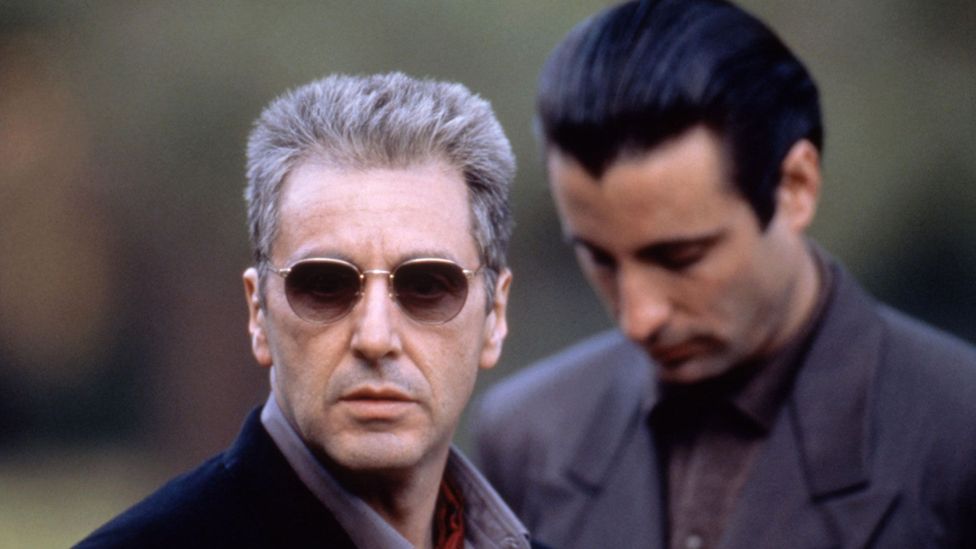
The mafia trilogy ended with a endmost chapter that has long been vilified. But as a new recut is released, 30 years on, Caryn James says it deserves to be re-evaluated.
T
The final part of the Godfather trilogy is considered such an artistic disaster that you'd call back Francis Ford Coppola had forgotten how to make a film in the 16 years that followed The Godfather Role II (1974). Part III's most famous dialogue – Al Pacino as the aging Mafia don Michael Corleone snarls, "But when I thought I was out, they pull me back in" – has go an easy laugh line.
More similar this:
– The ultimate lockdown horror
– Twelve films to watch in December
– Is this the cease of the gangster movie?
But 30 years subsequently its release, information technology is time to rescue Godfather Three from its terrible reputation. Pacino's eloquent, fiery, knowing central performance is supported by several bravura set pieces that are mini-masterpieces in themselves. With deliberate echoes of the earlier Godfather films, there is singing and dancing at a family political party, a bold murder during the San Gennaro street festival, a tragedy on the steps of an opera house in Sicily.
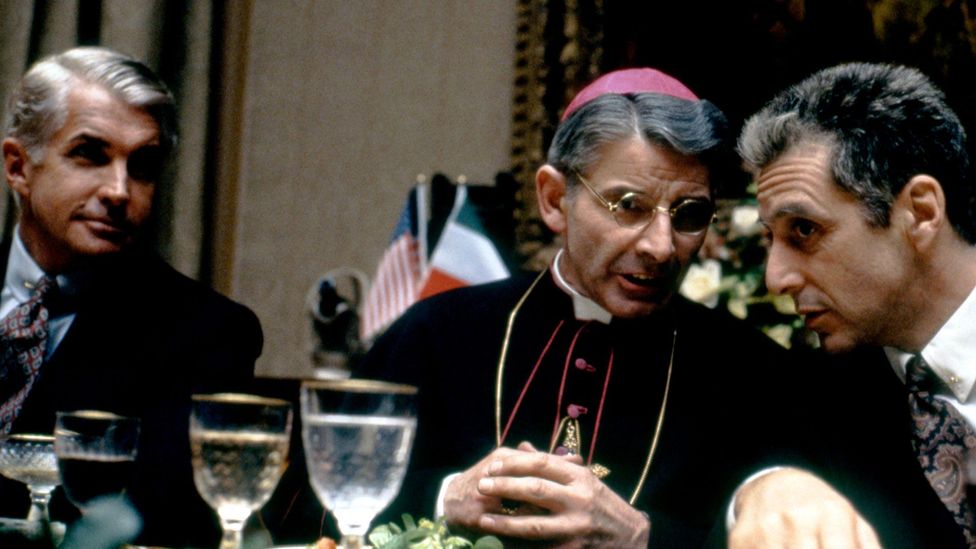
In the picture show's confusing main plot, Michael gets tangled up in dealing with the Vatican (Credit: Alamy)
Retrospect alone would tell us how seriously the film has been undervalued, fifty-fifty without Coppola'south newly restored, re-edited and renamed version. It now has the title Mario Puzo'southward The Godfather, Coda: The Expiry of Michael Corleone. Calling it a coda emphasises its connection to the earlier instalments, and even hints at its lesser stature. And the discussion 'death' signals its dark inevitability, although the pregnant of that word is slipperier than it first appears.
Twelve minutes shorter, it rearranges some key episodes, eliminates a few minor scenes and trims a line here or there. But until its altered ending, it is fundamentally the same film, better in parts than as a whole. It is too flawed to come shut to the accomplishments of The Godfather (1972) or its sequel, both among the most towering and influential films of the 20th Century. They have penetrated the culture, from their language ("I'm going to brand him an offer he can't refuse") to their quintessentially American story of immigration and upwards mobility. But the new version clarifies Coppola'south epic vision, revealing how much the Corleone story was always Michael's, a deeply moral saga of guilt and redemption. He only happened to be a mob boss.
Coppola was ever lucid most the trilogy'south vision, even when others were dislocated. "For me the tragedy of The Godfather, which is the tragedy of America, is about Michael Corleone," he says in the extras on a DVD set up of the three films released in 2001. He wanted The Death of Michael Corleone to be the title back in 1990, only Paramount, the studio releasing information technology, did non. The film'due south initial reception was measured disappointment, not dismissal or horror as we now assume. Roger Ebert actually loved information technology. Pauline Kael did not love or detest it, simply offered the withering, cavalier assessment. "I don't retrieve it's going to exist a public humiliation." Expectations were high because of the legacy of the earlier films, yet low because Function 3 came with a whiff of desperation and of selling out. Coppola had resisted making another Godfather for years, then wrote the screenplay (with Mario Puzo) and edited it in a rush to come across its Christmas Day release. It fifty-fifty got 7 Oscar nominations, including all-time flick and director. It is an odd example of a movie whose reputation has declined over the decades.
Why the film is misunderstood
Then and now, the serial has largely been misunderstood. Law-breaking movies similar Coppola'due south and Martin Scorsese'south are so seductive that audiences have embraced them for manifestly glamorising the beloved of raw power and the concept of honour among thieves. Beneath the Mafia-friendly surface, though, they are built on ethical themes their more than hot-headed characters don't grasp. The Godfather Coda tells us that crime really doesn't pay when you lot're prepare to search your soul. The young Michael struggles with the idea of killing and crime in the first Godfather. The consequences of his conclusion are central to Role Iii, which takes place in 1979, xx years after the events of Godfather Ii. Michael, a billionaire living in New York, has made his businesses legitimate and is left to grapple with his guilt for and then many crimes, peculiarly ordering the murder of his brother Fredo, who betrayed him.
The film still has problems that no amount of editing can alter. In a needlessly disruptive principal plot, Michael tries to take over a European conglomerate chosen International Immobiliare. By buying the Vatican's shares, he'll be bailing out the corrupt Vatican bank. The family unit part of the story revolves around Michael'due south nephew, Vincent Mancini, the illegitimate son of his brother Sonny. Andy Garcia is equally good a Vincent every bit you could hope for, handsome, swaggering, rough around the edges, dynamic on screen. But his character never makes much sense. Vincent has his father's explosive temper and ambition for violence, simply somehow goes from a non-so-vivid thug to a shrewd, controlled crime strategist in a matter of months. His alter is far from the engrossing, methodical graphic symbol trajectory that takes the young Michael from idealist to murderer in the get-go Godfather.
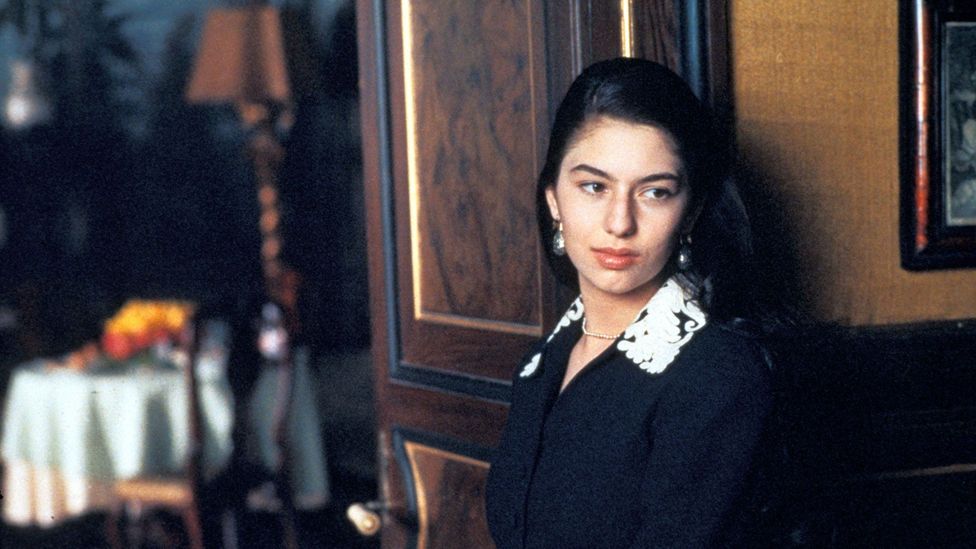
The movie's most severely criticised element has always been Sofia Coppola's performance as Michael'due south daughter Mary (Credit: Alamy)
And the film's most severely criticised element is no meliorate than anyone remembers. Winona Ryder, who had been set to play Michael's daughter, Mary, dropped out weeks before filming started and was replaced with unabashed nepotism past Coppola's teenaged daughter, Sofia. Today, we know Sofia Coppola as a brilliant director, but information technology's piece of cake to see why her amateurish functioning fabricated her another target of Godfather III jokes, particularly for the unintentionally awkward and passionless romance betwixt Mary and her cousin Vincent. Coppola actually snipped a couple of Sofia's lines in the new version.
He makes a major modify at the get-go of the re-edited pic, eliminating the lovely original offset. It prepare an elegiac tone past showing images of the abased family unit house in Lake Tahoe from Part II, and includes a flashback to Fredo's expiry, while Nino Rota's familiar soundtrack music evokes the by. The new version begins with a duplicitous archbishop soliciting Michael'south aid for the Vatican, a scene originally placed later in the film. The change highlights the finance plot without making it whatsoever clearer.
The exhilarating start
Only the moving picture presently picks upwards with its true, exhilarating beginning. Several generations of Corleones, along with friends and business organisation associates, gather at a party celebrating Michael. His sister, Connie, sings an Italian song, while shady-looking visitors pay homage to Michael in his function. He now has bristly grey pilus and a lined face, and controls his family and business with authoritarian power. The extravagant 30-minute sequence echoes Connie'southward wedding at the showtime of The Godfather, and the Showtime Communion party in Lake Tahoe that began Godfather II. Michael's role even has the same light slanting through the blinds that we saw in his father'southward office in the showtime Godfather, when Marlon Brando as Vito Corleone received visitors. Throughout, these call backs to the previous films add together resonance while trenchantly revealing how things take changed. Michael is burdened past conscience in a mode Vito never was. "I don't apologise," Vito tells Michael near the finish of The Godfather, justifying his brutality because he was trying to relieve his family. Godfather 3 is all most Michael's demand to atone.
The political party scene flows easily as it brings every character up to date. Diane Keaton is equally deft equally ever as Michael's ex-married woman Kay, who pleads with him to permit their son, Tony, to pursue a career as an opera singer. Kay can be chilling. "Tony knows that you killed Fredo," she warns Michael. Yet she has never got over him, as nosotros meet in a later on scene when they have a tearful tête-à-tête in Sicily, a scene Pacino and Keaton make painfully real.
Connie, played with glorious sharpness and wit by Talia Shire, has morphed into Lady Macbeth. Mafia princesses can never run things, simply they tin can pull the strings. Information technology's Connie who ruthlessly tells Vincent, "You're the but i in this family with my male parent'south strength. If anything happens to Michael I want yous to strike back." She has asked the right person.
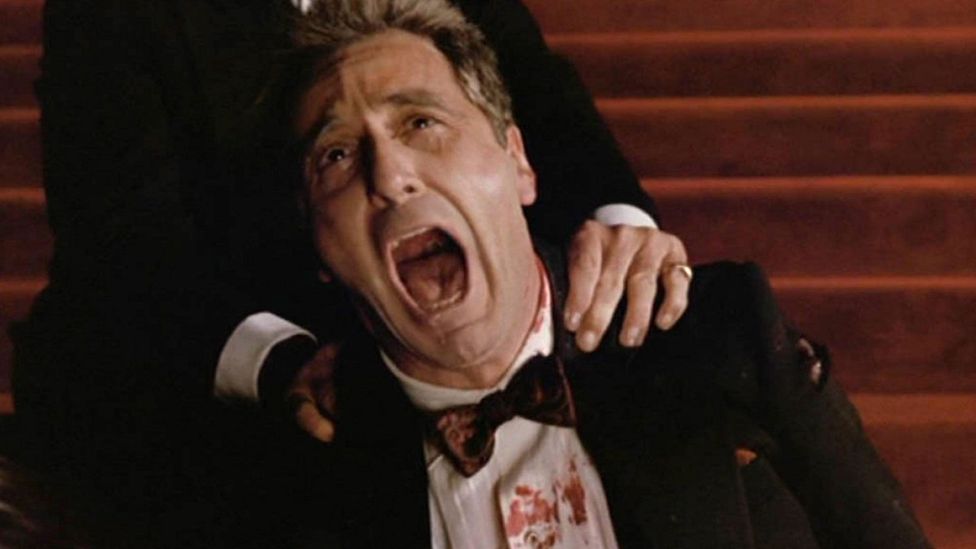
The flick builds to a last tragic sequence at the opera, where Michael is pursued by hitmen (Credit: Alamy)
Vincent is fundamental to many of the prepare pieces. During a meeting of Mafia heads in Atlantic City, when Michael announces he is out of the crime business, a helicopter approaches the window and shoots nigh of them expressionless. Vincent rushes Michael, the primary target, to condom. The intrigue and rapid-fire violence in the perfectly orchestrated scene might obscure the existent point: Michael can't escape his by. That attack causes his weep: "Just when I thought I was out..." Pacino's performance may accept become an object of derision, merely he knows what he's doing. He is raw and angrily over-the-pinnacle in some scenes, just modulates those outbursts with quieter moments. When a stress-induced diabetic assault sends him to the infirmary, in his delusional state he calls out Fredo's name. Pacino shows us a conflicted Michael, weakened withal clinging to power.
The ability of the re-edited finale
The tone becomes more ominous and the themes more spiritual when the entire family goes to Sicily for Tony's opera debut. (At that place are spoilers hither, only the fourth dimension limit on spoilers has expired later on xxx years.) Michael grapples with the Sicilian Mafia, for reasons linked to the Immobiliare bargain, but that is less of import than his inner crisis. He makes a confession to a key, breaking down in tears as he says, "I'm beyond redemption." When his protector, Don Tommasino, becomes another victim of Michael's power struggle, he sits by the coffin and says to God, "I swear on the lives of my children, give me a chance to redeem myself and I volition sin no more." In this version, Coppola eliminates lines in which Michael asks why he is feared and non loved, removing that plea for the audience's sympathy. Michael gives Vincent control of the family, merely does he really have a clear conscience when he knows as well well the vengeance Vincent will programme?
That revenge plays out in the elaborate, gripping final sequence at the opera, a counterpart to ane of the most famous episodes from The Godfather, when a baptism is intercut with a serial of murders. That start sequence was about Michael'southward rise to power; now he suffers the consequences. While the family watches Tony on stage, Coppola weaves in scenes of Vincent's crew settling scores. One shoots an enemy who plummets off a beautiful screw staircase. Another murders a rival by stabbing the man's own eyeglasses into his cervix. At the opera, hitmen are after Michael, which leads to the shooting on the steps, and a bullet meant for him that kills Mary. For him in that location is no coming back from that, no possible manner to forgive himself.
As the flick ends, Coppola makes a brilliant editing choice. The original catastrophe flashed ahead years to the elderly Michael, sitting alone in a gravelly yard as the camera closes in on a confront yet total of pathos and sadness. He falls to the ground, manifestly dead. With a tiny cutting, Coppola transforms the significant of the scene. It now ends with the close-up of Michael's face, still alive. Living with his guilt is his true death, a death of the soul and of hope. Coppola adds text at the cease, which says: "When the Sicilians wish you 'Cent'anni'... it means 'for long life'... and a Sicilian never forgets." Michael is doomed to a long life of remembering.
Godfather, Coda restores Coppola's original darker vision, but one element creates a jolt even he couldn't accept seen coming. The locations listed in the terminate credits include Trump Castle Casino Resort in Atlantic City, where the exterior of the helicopter assail was shot. The Trump era has been full of Godfather references. Some are from mainsteam media, including a 2018 Atlantic Magazine article with the headline Donald Trump Goes Full Fredo, comparison a Trump tweet saying that he is "like, really smart" to Fredo famously insisting in Godfather II, "I'k smart! Not like everybody says, similar dumb, I'm smart!" Similarly, Twitter trolls routinely mock the president's circle and his grown children as Fredos, portraying them every bit weak and bumbling like the character, including pasting Donald Trump Jr's caput on a photograph of Fredo'due south body. Donald Trump himself regularly attacks CNN's Chris Cuomo by calling him Fredo. Godfather II even turned upwards in court documents charging Trump'due south advisor Roger Stone with obstructing justice, citing an email in which Rock asked someone to protect him the mode Frankie Pentangeli covered up for the Corleones. Today the location credit lands similar a coda to the terminate of the Trump presidency, and offers a reminder of how influential the Godfather films have been, even when they were embraced for all the wrong reasons.
Mario Puzo'due south The Godfather, Coda: The Death of Michael Corleone is available on BluRay and streaming from 8 December.
Love film and TV? Join BBC Culture Movie and TV Club on Facebook, a community for cinephiles all over the world.
If you lot would like to comment on this story or anything else you have seen on BBC Culture, head over to our Facebook page or message us on Twitter .
And if you lot liked this story, sign up for the weekly bbc.com features newsletter , chosen The Essential List. A handpicked selection of stories from BBC Future, Civilisation, Worklife and Travel, delivered to your inbox every Fri.
Source: https://www.bbc.com/culture/article/20201201-why-the-godfather-part-iii-has-been-unfairly-demonised
0 Response to "What Was the Family Name in the Godfather Trilogy?"
Enregistrer un commentaire